 Dlightning

You have an accent. Everyone you've ever spoken to can hear it, and you can't. It's the one voice in the world your own ear was built to skip past, because it's the sound you tune every other voice against. To you it isn't an accent at all. It's simply how words are supposed to come out.
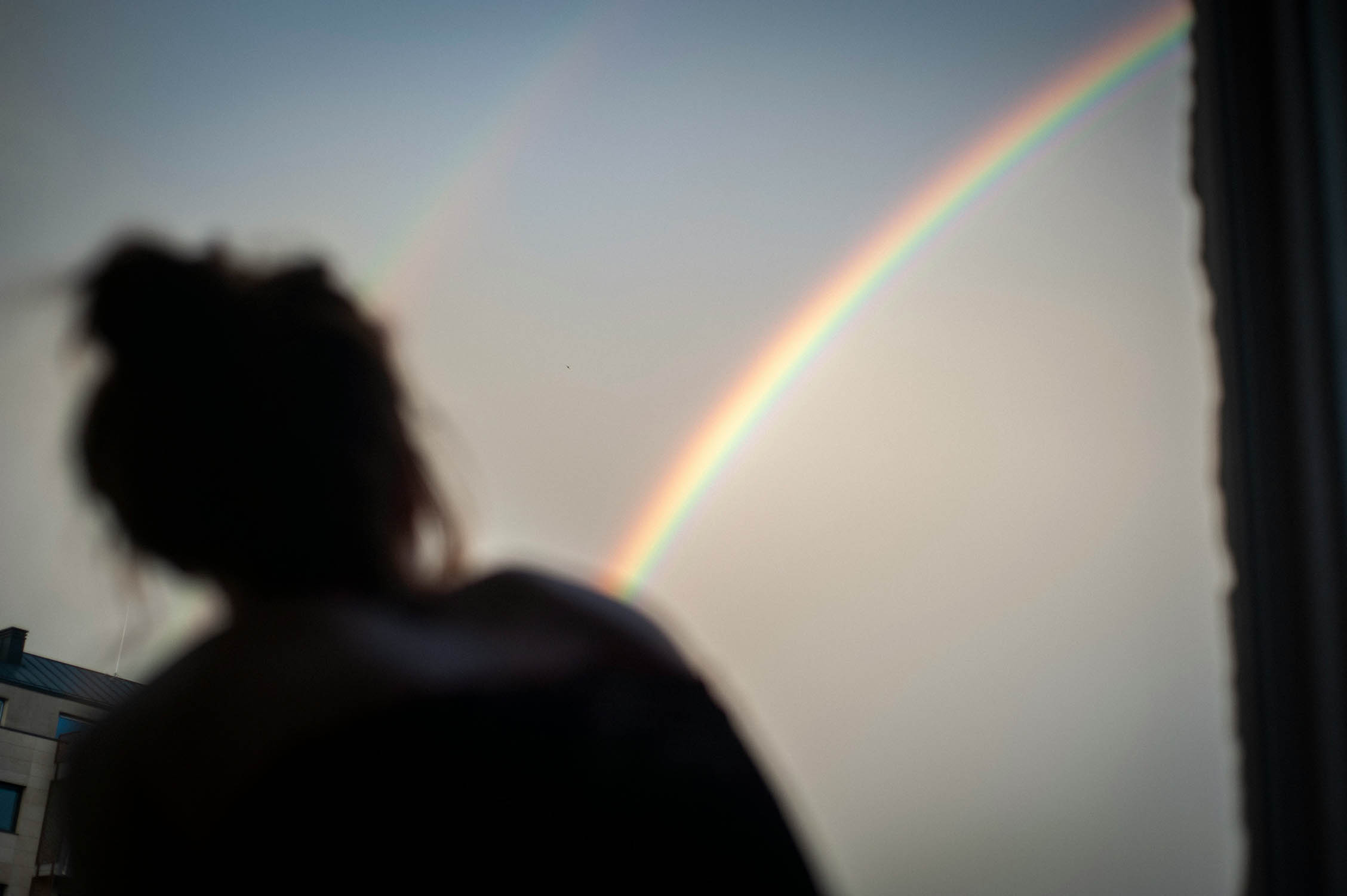
A lens works the same way. It does its job by disappearing. Look through your glasses and you see the street, not the glass; the second you notice the glass, it's failing at being a lens. Whatever you see through, you don't see.
The eye takes this to its limit. All of your seeing passes through the cornea, a dome of clear tissue at the front of the eye, and you have never once seen it. It manages that by carrying no blood vessels, the only tissue in the body that draws its oxygen straight from the air, kept transparent so nothing of itself ever lands in the picture. Wittgenstein put the same point in colder language: nothing in what you see tells you there's an eye doing the seeing. The one thing guaranteed absent from your field of view is the vantage the whole field is arranged around.
So the instrument of perception is a dependable blind spot. Not a gap at the edge you could turn your head to catch. The blind spot is the position itself.
It reaches past optics, into the frames we think with. For a long stretch of history, Greek had no word for blue that would create a clear distinction between it and green or grey; Homer sends his ships across a "wine-dark sea," and it took a nineteenth-century classicist, William Gladstone, sitting down to count the color words in the Odyssey, to notice an absence nobody inside the language had ever felt as missing. Closer to now, researchers found that Russian speakers, whose language splits light blue and dark blue into two separate basic words, are measurably quicker to tell those two blues apart than English speakers, who file both under one word and stop looking. The vocabulary you were handed did more than name the colors. It set which differences would look obvious to you and which you'd have to strain to see at all.
You feel it in smaller ways too. Read something you wrote three years ago and the tic leaps out: the phrase you lean on, the move you make every time, invisible while you were making it because it was simply your writing. An accent, a mother tongue, a house style, a field's founding assumptions — each one turns unseeable in exact proportion to how well it works. Fluency is the point where the frame stops registering as a frame.
This is the part that should sober anyone who builds. The assumptions sunk deepest into a thing are the ones its makers never chose on purpose, because they never appeared as choices. They arrived as "how it's done." A team fluent in its own product grows an accent it can no longer hear: the flow that feels natural, the order the questions come in, the word on the button that means something exact only to the people who wrote it. Users hit those every day. The people who made them can't, the way you can't tickle yourself. The hardest thing to test is never the feature everyone argued over. It's the assumption nobody knew they'd made.
Which is why the most useful person in the room is often the one who isn't fluent yet. The new hire in their second week. The user who wandered in from some other world and keeps "misreading" the screen. They aren't seeing it wrong. They're seeing it without the lens you were issued, and they're reporting the shape of the glass you forgot was there.
You won't ever get a clean look at your own frame. You can't step outside your eyes to inspect the cornea, and you can't step outside your mind to audit it either, because whatever you'd use to do the looking is cut from the same glass. What you get instead are glances, sideways: the reader who stumbles where you were sure the path ran straight, your own voice startling you off a recording, the color you finally see the day someone hands you the word for it. The lens never turns visible. Its edges do, for a second, when something refuses to line up with it. Those seconds are as close as you come to seeing what you see with. Don't explain them away. That's the frame, catching the light.